


 Seenclassified
 Request Access
What Causes Erratic Behavior in Aluminum TIG Welding?
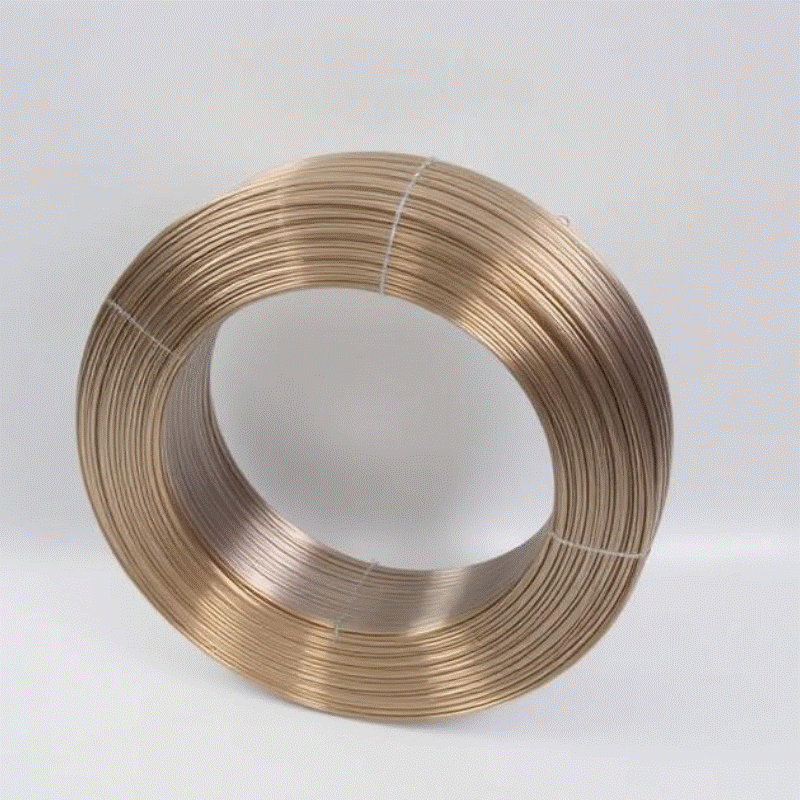
Welding aluminum requires precision that extends beyond operator skill and equipment settings. The materials themselves must meet exacting standards, and Aluminum TIG Wire Suppliers recognize that dimensional accuracy directly affects weld quality. When filler wire diameter varies along its length, even by small amounts, the resulting inconsistencies can disrupt the delicate balance of heat input and metal deposition that characterizes successful TIG welding.
The TIG process relies on precise control of multiple variables working in harmony. Wire feed rate, amperage, travel speed, and shielding gas flow all interact to create a stable weld pool. When wire diameter fluctuates, it introduces an uncontrolled variable into this equation. Thicker sections require more heat to melt, while thinner sections melt too quickly, creating irregular metal transfer into the pool. This inconsistency manifests as uneven bead appearance, porosity, and weak fusion between passes.
Operators notice these issues immediately. A weld that starts smoothly may suddenly develop erratic behavior as the wire diameter changes. The arc may sputter or become unstable, forcing adjustments to technique or parameters mid weld. In critical applications where x-ray or visual inspection standards apply, these defects necessitate rework or rejection, increasing costs and delaying project completion. Consistent wire diameter eliminates this source of variability, allowing welders to focus on technique rather than compensating for material irregularities.
Manufacturing processes determine the dimensional accuracy of finished wire products. Drawing operations must maintain uniform tension and die wear patterns to produce wire with tight tolerances. Quality control systems measure diameter at multiple points along each coil, rejecting product that falls outside acceptable ranges. Temperature control during processing prevents variations in material properties that could affect final dimensions. These manufacturing disciplines separate reliable suppliers from those whose products create problems on the shop floor.
Wire straightness interacts with diameter consistency to affect feeding behavior. TIG welding typically involves hand feeding wire into the pool, though automated systems exist for production work. Bent or kinked wire resists smooth feeding, causing the operator to push harder or adjust grip. When combined with diameter variations, these feeding difficulties compound, making it nearly impossible to maintain steady metal deposition. Proper spooling and storage practices preserve wire geometry from factory to welding torch.
Alloy composition affects melting characteristics, but geometry determines how predictably that melting occurs. A wire with consistent diameter melts uniformly along its length, creating a steady stream of filler metal into the pool. This predictability allows operators to develop muscle memory and rhythm, essential elements of quality TIG welding. Inconsistent wire forces constant adjustment, preventing the smooth, flowing technique that produces attractive, sound welds.
Aluminum Tig Wire Suppliers who invest in precision manufacturing equipment and quality systems provide tangible value to their customers. Welding operations experience fewer defects, reduced rework, and improved productivity when using dimensionally accurate wire. Training new welders becomes easier when material quality removes one source of confusion and frustration. Even experienced operators appreciate wire that behaves predictably, allowing them to focus on joint preparation and technique refinement.
Testing protocols verify that wire meets specifications before reaching end users. Measuring instruments track diameter variation across representative samples from each production lot. Surface finish receives similar attention, as roughness or contamination can affect arc stability. Documentation systems trace material from raw stock through finished product, enabling investigation if field issues arise.
The relationship between wire geometry and weld pool behavior demonstrates how seemingly minor material characteristics influence final results. Diameter consistency represents a fundamental quality attribute that separates functional filler wire from premium products engineered for demanding applications. Welding operations that prioritize quality outcomes recognize the value of working with Aluminum Tig Wire Suppliers who maintain rigorous manufacturing standards and quality control systems throughout their production processes. Additional details about welding wire products are available at www.kunliwelding.com .
Invest in Luxury
Access curated opportunities across luxury assets, private markets, and alternative investments designed for long-term value creation and portfolio diversification.
Explore Opportunities
Private Cannabis Investing
The global cannabis market is expected to grow rapidly in the coming years. With this growth, investing with TheSeattleCannabis can be a smart move for those looking to diversify their portfolio. .
View Opportunities Portuguese
 English
 Arabic
 French
 Spanish
 Deutsch
 Turkish
 Dutch
Dutch
 Italiano
 Russian
 Romaian
 Portuguese (Brazil)
 Greek
Greek